


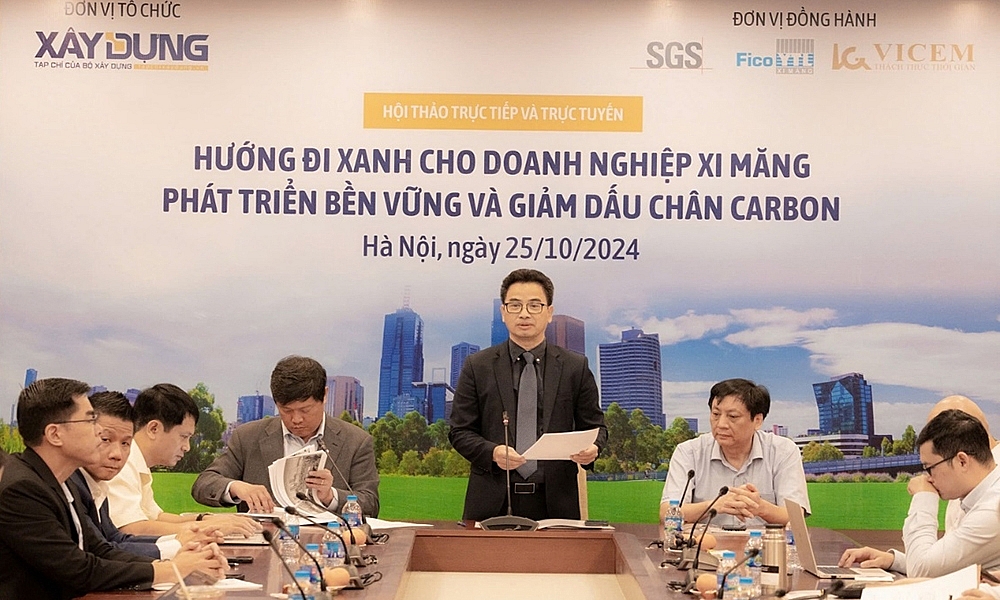
Regulations on greenhouse gas emission reduction in the cement industry
In his opening speech at the workshop, Director of the Department of Science, Technology and Environment Vu Ngoc Anh said that cement enterprises are currently facing a lot of pressure in implementing Vietnam’s commitments on climate change and energy transition. Enterprises need to comply with new national and international regulations, including the use of alternative fuels, the application of energy-saving technologies, and improvements in production processes to reduce greenhouse gas emissions.
Director Vu Ngoc Anh also emphasized the importance of innovation in management and marketing to find new markets.
According to Decision No. 13/2024/QD-TTg, effective from October 1, 2024, 80 cement production facilities will be required to conduct greenhouse gas inventories and submit reports every two years, according to Decree No. 06/ND-CP. The Ministry of Construction has also prepared two important drafts: The plan to reduce greenhouse gas emissions in the fields under the management of the Ministry of Construction until 2030, including the cement production sector; Circular guiding the process and technical regulations for greenhouse gas inventory, measurement, reporting, and assessment of greenhouse gas emission reduction in the construction sector.
In addition, the Ministry of Natural Resources and Environment is coordinating with ministries and branches to amend Decree No. 06/2022/ND-CP, in order to perfect regulations on greenhouse gas assessment, carbon market organization, and carbon credit management.
The workshop “Green direction for cement enterprises to develop sustainably and reduce carbon footprint” is of great significance for management agencies, consulting units, and cement enterprises to exchange and discuss essential issues that the industry is facing, and is also an opportunity to help enterprises better understand regulations on greenhouse gas emission reduction.
In addition, the Workshop provided information on the European orientation on the Carbon Border Adjustment Mechanism (CBAM) and the European Union Emissions Trading System (EU ETS), thereby helping Vietnamese enterprises improve their competitiveness in the ASEAN region.
Cement production in the direction of saving resources, saving energy, reducing emissions
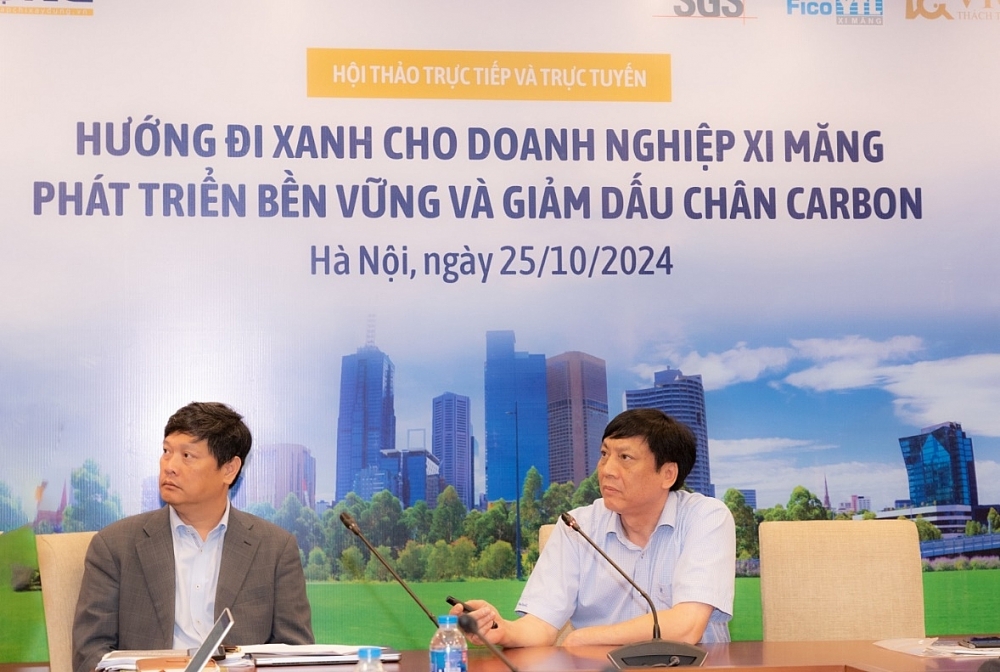
At the workshop, Deputy Director of the Department of Construction Materials Hoang Huu Tan presented a paper on “Vietnam’s Cement Industry Aims for Sustainable Development”. Deputy Director of the Department of Construction Materials Hoang Huu Tan shared the development orientation of Vietnam’s Cement Industry in the coming time, focusing on the economical use of mineral resources, energy saving, emission reduction, and linking production with recycling, reuse of waste, and waste treatment and environmental protection.
Currently, Vietnam’s Cement Industry has 92 clinker production lines, with a total capacity of 122.34 million tons of cement per year. In terms of raw material consumption, on average, each ton of clinker consumes 1.55 tons of raw materials (limestone, clay, additives), while the average thermal energy consumption is 800 kcal/kg of clinker and the electricity is 95 kWh/ton of cement.
The development goal of the Cement industry in the period of 2021-2030 includes only investing in the construction of new clinker factories with a capacity of over 5,000 tons/day, linked to raw material areas and waste heat utilization systems. By 2025, clinker lines with a capacity of less than 2,500 tons/day will have to innovate technology. The industry also aims to reduce heat energy consumption to below 730 kcal/kg of clinker and electricity to below 90 kWh/ton of cement. By the end of 2025, 100% of clinker lines larger than 2,500 tons/day must have waste heat utilization systems.
In the period of 2031 – 2050, the Cement industry will focus on developing a circular economy in production, using waste and garbage as raw materials. Co-processing of waste in cement kilns will be promoted to reduce the amount of waste that must be landfilled and improve economic efficiency. At the same time, existing production lines will be improved to process most types of waste without generating pollution, thereby contributing to reducing emissions to the environment.
The cement industry will also focus on using resources economically, encouraging negative exploitation and protecting the environment. The goal is for 100% of production facilities to meet environmental requirements, while applying modern dust filtration technology and online dust concentration monitoring equipment to improve environmental management efficiency.
Solutions to reduce greenhouse gas emissions in the Cement Industry
The Vietnamese Cement Industry plays an important role in infrastructure and socio-economic development. Currently, the Industry has a total designed capacity of up to 122 million tons of cement/year, of which VICEM accounts for about 30-32%. This industry has a large proportion of greenhouse gas emissions, accounting for nearly 75% of the total emissions of the Construction Materials Industry.
Currently, emissions for clinker production average about 900kg CO2/ton, with emissions from raw materials about 530kg, fuel about 315kg and electricity use about 55kg. For cement production, emissions are about 670kg CO2/ton. The Vietnam Construction Materials Development Strategy for the 2021-2030 period, with a vision to 2050, was approved by the Prime Minister in Decision No. 1266/QD-TTg dated August 18, 2020. The goal is to reduce CO2 emissions to below 650kg/ton of cement by 2030 and 550kg/ton by 2031-2050.
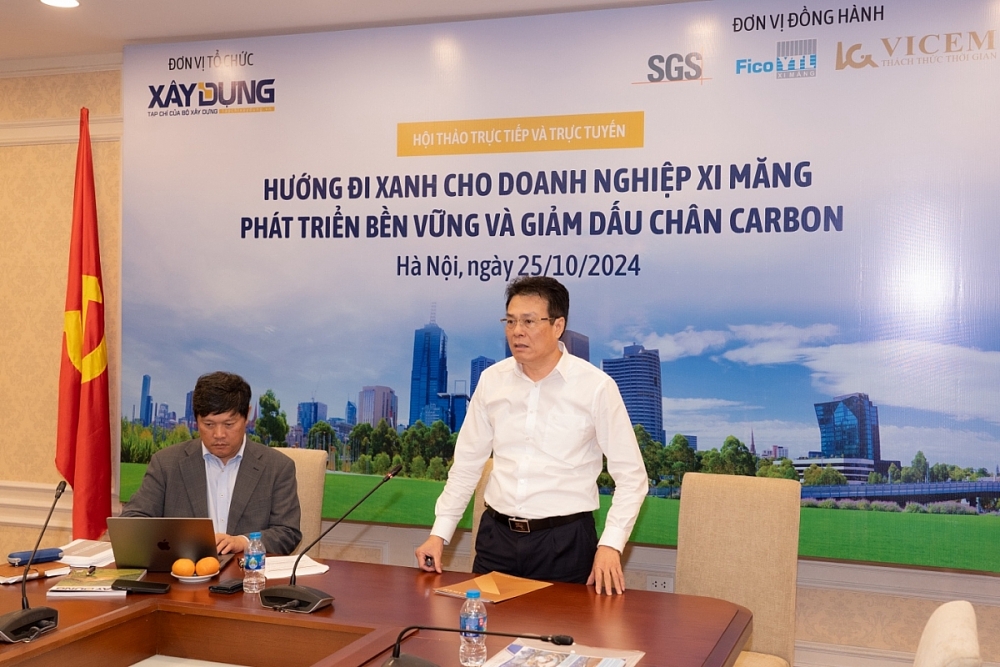
Sharing about the solution to reduce greenhouse gas emissions in the cement industry, Deputy General Director of Vietnam Cement Corporation (VICEM) Pham Ngoc Truong said: VICEM has made significant progress in reducing greenhouse gas emissions. According to the report from the MRV measurement and verification tool, the average emissions for clinker production recently reached about 872 kg CO2/ton. For cement production, this figure in 2023 is about 617 kg CO2/ton, and 610 kg CO2/ton in the first 9 months of 2024. These results confirm that VICEM is getting closer to its strategic goals.
To achieve the emission reduction target, VICEM has implemented many solutions such as: Emission management and control; Optimizing fuel use; reducing the proportion of clinker in cement production; utilizing excess heat to generate electricity and recover CO2. According to the Deputy General Director of VICEM, despite many advances, VICEM still faces difficulties in maintaining product quality and investing in infrastructure for alternative materials. Furthermore, support policies from the State are still lacking in specificity, causing difficulties for businesses. VICEM affirms its commitment to pursuing sustainable development and green production, and calls on the State to soon have support policies to promote environmentally friendly production, helping the construction materials industry develop more sustainably.
 Representative of Fico – YTL Cement Joint Stock Company presented a paper.
Representative of Fico-YTL Cement Joint Stock Company (Fico-YTL) also presented on research and development of low clinker content cement, with the goal of mastering clinker activity to ensure the best quality. The company pays special attention to understanding customers’ needs and applications, and applies its own grinding technology to reduce clinker content. In addition, the company also researches the application of minerals in industrial waste and effectively uses chemical additives suitable for clinker properties to optimize the product.
Fico-YTL also introduced the green cement product ECOCem, which has the advantage of CO2 emissions being at least 30% lower than Portland cement, along with reduced clinker content and the use of alternative raw materials. These efforts not only improve the quality of cement but also promote sustainable development in the industry.
In addition, Fico-YTL recommends promoting a green transformation roadmap for the Cement industry, specifically: Planning supply and demand and sustainable industry structure, guiding green transformation of cement units, referring to models from countries around the world such as China. In addition, it is necessary to plan supply and demand by region, prioritize the use of blended cement instead of portland and take advantage of the co-processing capacity of the industry. The early promulgation of national green building standards is also emphasized to promote sustainable development in the Cement industry.
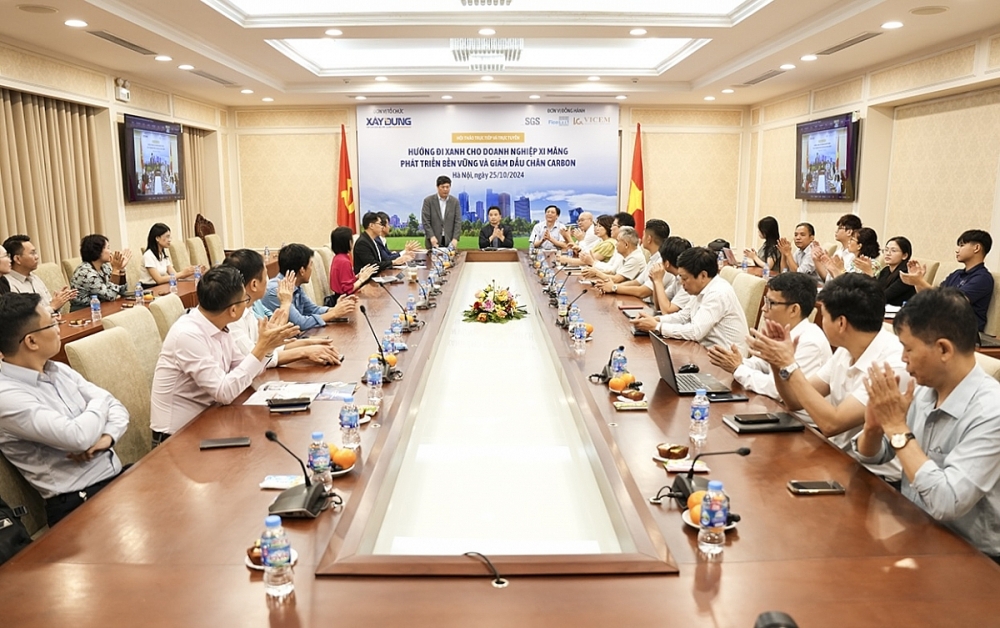 Overview of the Workshop.
At the workshop, the Department of Science, Technology and Environment of the Ministry of Construction presented a draft guideline for the greenhouse gas inventory process and many opinions from experts were also given on international commitments related to climate change and legal regulations on greenhouse gas emission reduction in Vietnam.
At the same time, experts, managers, scientists and businesses actively exchanged and discussed to propose specific solutions for the strategy of compliance and greenhouse gas emission reduction in the cement industry, and at the same time build a comprehensive roadmap to promote sustainable development, towards the goal of reducing carbon footprint.